> For the complete documentation index, see [llms.txt](https://docs.seldon.ai/seldon-enterprise-platform/llms.txt). Markdown versions of documentation pages are available by appending `.md` to page URLs; this page is available as [Markdown](https://docs.seldon.ai/seldon-enterprise-platform/demos/seldon-core-v2/explainer-tabular.md).
# Tabular Explanations
In this demo we will:
* Create a pipeline which can be used to classify tabular data
* Create an explainer that will offer insight into why a particular prediction was made for a given input
* Send a prediction request to the pipeline
* View the explanation
{% hint style="info" %}
**Note**: This demo uses a model trained to predict high or low income based on [demographic features from a 1996 US census](https://archive.ics.uci.edu/dataset/20/census+income).
{% endhint %}
## Register an income classifier model
Register a pre-trained income classifier SKLearn model. See the ["Register an income classifier model"](/seldon-enterprise-platform/demos/seldon-core-v2/drift-detection.md#register-an-income-classifier-model) section in the Drift Detection demo for detailed instructions.
## Configure predictions schema for classifier
Edit the model metadata to update the prediction schema for the model. See the ["Configure predictions schema for classifier"](/seldon-enterprise-platform/demos/seldon-core-v2/drift-detection.md#configure-predictions-schema-for-classifier) section in the Drift Detection demo for detailed instructions.
## Launch a Seldon ML Pipeline
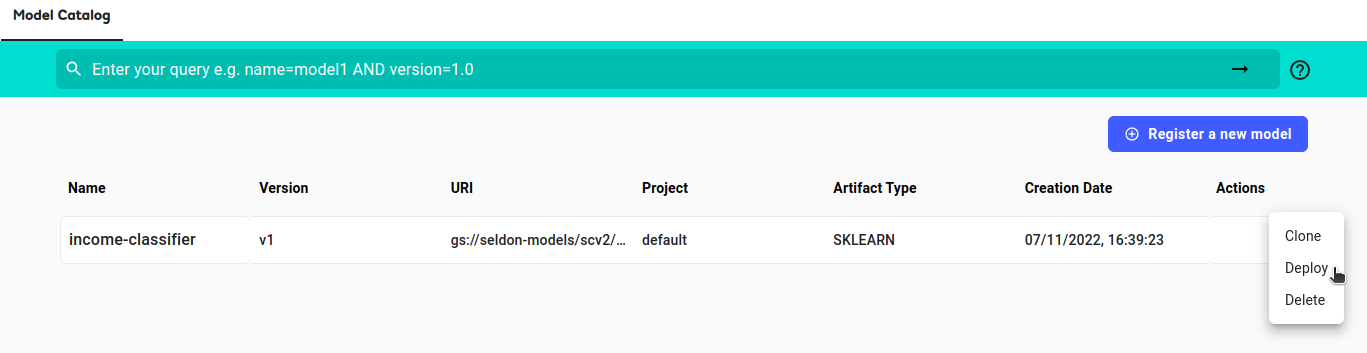
1. Navigate to the `Model Catalog` page where the model was registered.
2. Find the model and under the `Action` dropdown list, select `Deploy`.
Deploy model
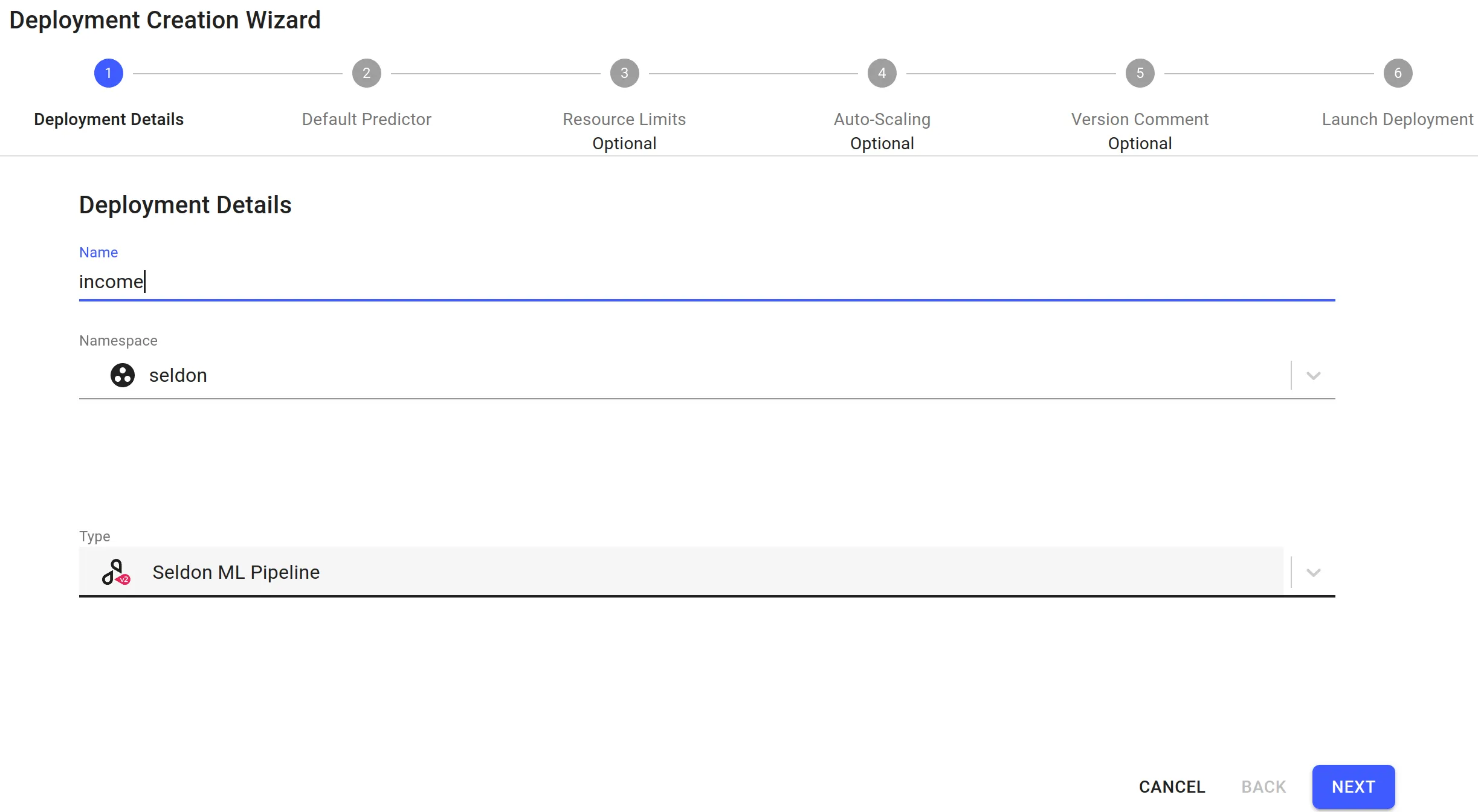
3. Enter the deployment details in the deployment creation wizard and click `Next`:
* Name: *income-classifier*
* Namespace: *seldon*
* Type: *Seldon ML Pipeline*
Deploy pipeline
4. The default predictor should already be filled in from the model catalog. Click `Next`.
5. Click `Next` for the remaining steps, then click `Launch`.
6. If your deployment is launched successfully, it will show an `Available` status in the `Overview` page.
## Get Predictions
1. Click on the `income-classifier` pipeline created in the previous section to enter the deployment dashboard.
2. Inside the deployment dashboard, on the left navigation drawer, click on the `Predict` button.
3. On the `Predict` page, enter the following text:
```json
{
"inputs": [
{
"name": "income",
"datatype": "INT64",
"shape": [1, 12],
"data": [53, 4, 0, 2, 8, 4, 2, 0, 0, 0, 60, 9]
}
]
}
```
4. Click the `Predict` button.

## Add an Explainer
There are currently 2 explainers available for tabular data classification:
* Anchor Explainer
* Kernel SHAP Explainer
1. From the `income-classifier` deployment dashboard, click `Add` inside the `Model Explanation` card.
2. For step 1 of the Explainer Configuration Wizard, select `Tabular` then click `Next`.
3.
{% tabs %}
{% tab title="Anchor Explainer" %}
For step 2, set the following details:
```
- Explainer Algorithm: Anchor
```
For step 3, set the following details:
```
- Explainer URI: gs://seldon-models/scv2/samples/mlserver_1.6.0/income-sklearn/anchor-explainer
- Explainer Project: default
```
{% endtab %}
{% tab title="Kernel SHAP Explainer" %}
For step 2, set the following details:
```
- Explainer Algorithm: KernelShap
```
For step 3, set the following details:
```
- Explainer URI: gs://seldon-models/scv2/samples/mlserver_1.6.0/income-sklearn/kernel-shap-explainer
- Explainer Project: default
```
{% endtab %}
{% endtabs %}
4. Skip step 4
5. For step 5, set following details
```
- Memory: 1Gi
```
6. Click `Next` for the remaining steps, then click `Launch`.
7. If your explainer is launched successfully, both the pipeline and the explainer will show an `Available` status.
## Explain a Prediction
1. Navigate to the `Requests` page using the left navigation drawer.
2. Click on the `View explanation` button to generate explanations for the request.
{% tabs %}
{% tab title="Anchor Explainer" %}
  
{% endtab %}
{% tab title="Kernel SHAP Explainer" %}
 
{% endtab %}
{% endtabs %}
Congratulations, you've created an explanation for the request! 🥳
## Next Steps
Why not try our other [demos](/seldon-enterprise-platform/demos.md)? Ready to dive in? Read our [operations guide](/seldon-enterprise-platform/operations.md) to learn more about how to use Enterprise Platform.